Our solutions and developments
D'Elite VisionGuard
Innovative products and technologies for investors and partners
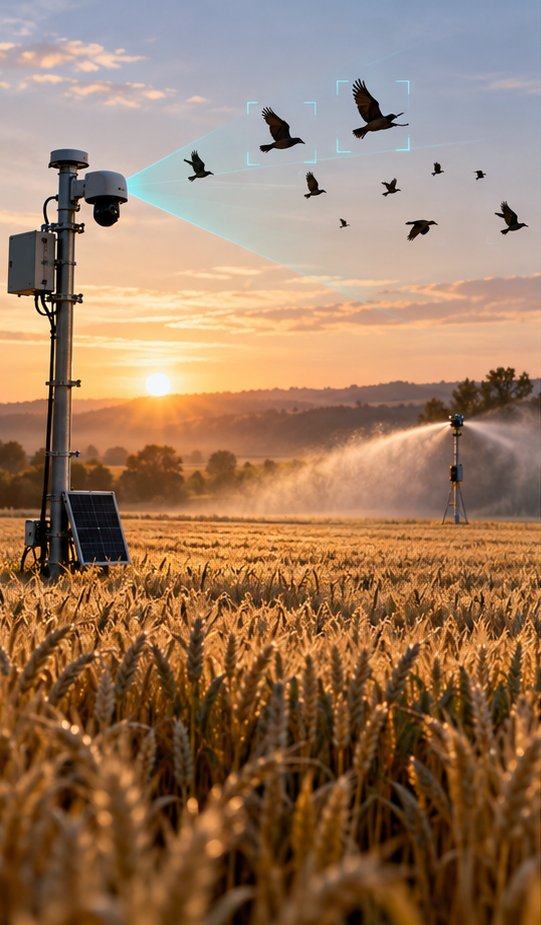
Conceptual visualization
Perception as the first step to action
D'Elite VisionGuard is a computer vision software module for detecting target objects, estimating their position, and transmitting the result to an external application or robotic platform.
The core already works on local frame processing: replaceable detection models, live stereo mode on a pair of cameras, rollback to mono in case of sensor degradation, and provisions for NV/thermal sources.
1
One module - different practical scenarios
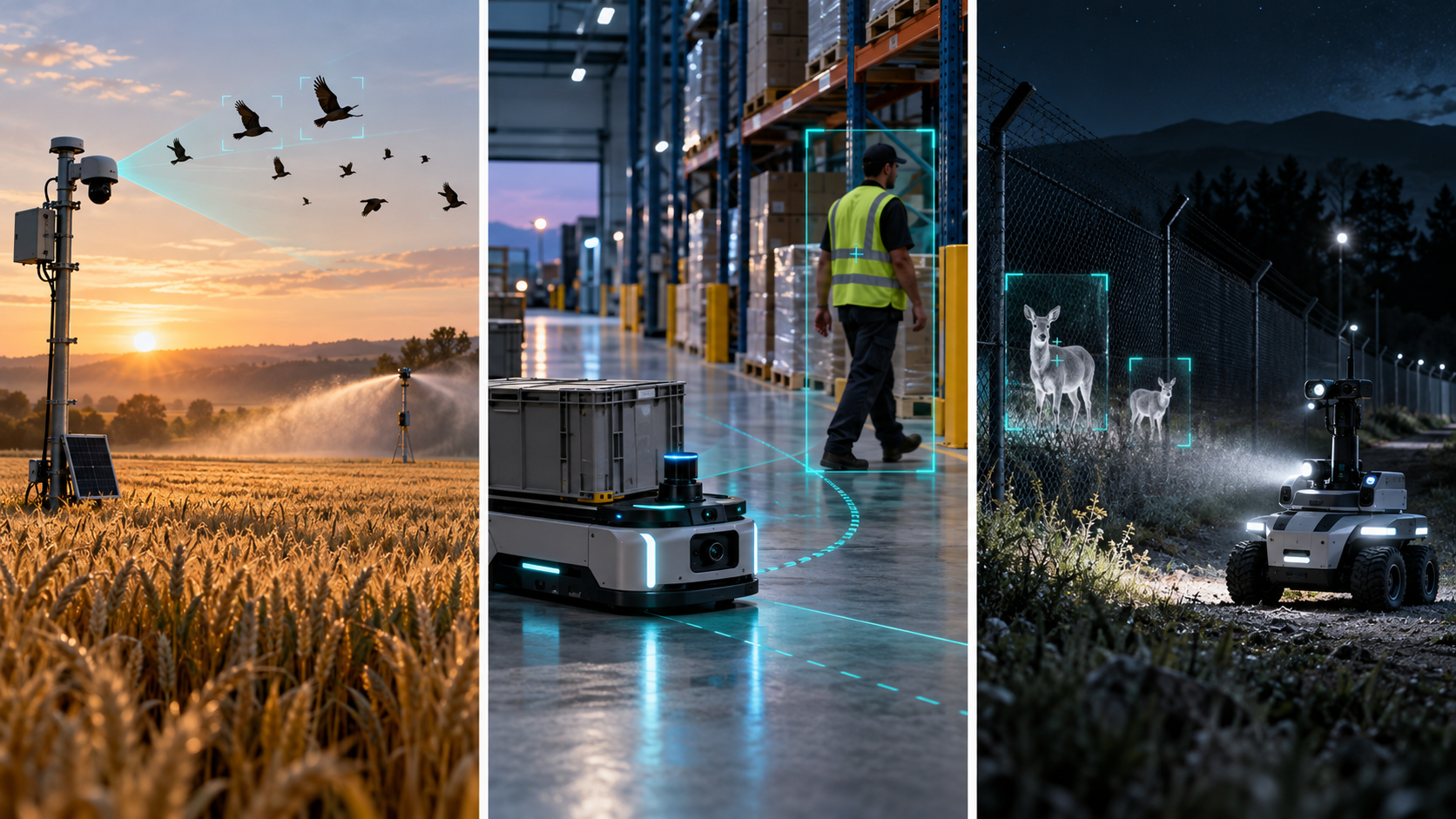
Agricultural sector
Detection of birds near crops and deployment of selected non-violent repellents.
Detection of birds near crops and deployment of selected non-violent repellents.
Mobile robotics
Transmitting coordinates and events to the robot to check an area, avoid an obstacle, or continue the mission.
Transmitting coordinates and events to the robot to check an area, avoid an obstacle, or continue the mission.
Night monitoring
Ability to connect an NV camera, thermal imager, and IR trigger for low-light scenarios.
Ability to connect an NV camera, thermal imager, and IR trigger for low-light scenarios.
2
How does the processing take place?
- The cameras transmit images with timestamps.
- The model finds objects of the selected class and selects the target object.
- A stereo pair estimates coordinates; with a single camera, an explicitly labeled mono result is returned.
- The result and status of the sensors are available to the operator or the autonomous circuit.
Prototype validation
What has already been proven in a real run
The technical risk to the perception core was eliminated on the test bench: after mono checks, a live stereo prototype was tested on a pair of cameras. Stereo mode was stable, distance estimation was consistent with the control measurement at the operating range, target selection and safe failure upon video loss were confirmed.
For the investor
The stereo perception core has already been proven on hardware: detection, triangulation, and fallback are working. Phase 1 is closed; now we're working on the target models and sensor circuit, followed by a pilot on the customer's equipment with calibration for a specific setup.
Close range
If the object is cut off by the bottom of the frame, the stereo anchor switches to the head (auto/top), and mono adjusts the apparent height - less z-errors on the robot's approach.
3
Sensors enhance different parts of the system
Stereo RGB
A pair of cameras have already been tested live: synchronization, matching, and triangulation of coordinates in a common system.
A pair of cameras have already been tested live: synchronization, matching, and triangulation of coordinates in a common system.
NV and thermal imager
Additional images can improve observation in twilight and dark conditions.
Additional images can improve observation in twilight and dark conditions.
IR sensor
Serves as a presence or movement trigger and helps avoid running a full analysis unnecessarily.
Serves as a presence or movement trigger and helps avoid running a full analysis unnecessarily.
Laser rangefinder
Can specify the distance to the object at which the beam is aimed.
Can specify the distance to the object at which the beam is aimed.
Sensor logic support is provided in the software core. Hardware adapters and field testing of additional sensors are performed separately.
4
Connecting with the Autonomy Layer
VisionGuard reports what the system sees. The Autonomy Layer decides how to carry out the mission.
The intended connection: target coordinates and sensor status are fed to the robotic circuit, which initiates the mission step, records events, and implements a failure recovery policy.
The ROS 2 bridge and the Autonomy Layer simulation framework are separate. Integration with VisionGuard and the physics platform is not yet complete.
5
Implementation phases
Phase 1Prototype and basic validationCompleted
Completed: mono- and stereo prototype on live cameras, stable mode=stereo, consistent range estimation at working range, target selection and safe-idle.
Phase 2Target models and sensory circuitCurrent
Configuring interchangeable models for specific object classes, assessing detection quality, and connecting additional sensors according to a scenario.
Phase 3Integration pilotPlan
Coordinates and events are transferred to the Autonomy Layer, and the mission is verified in simulation and on the customer's platform. Stereoscopic calibration of the pair is performed on a specific device within the installation, tailored to the camera geometry and site setup.
Phase 4Field testing and scalingPlan
Verify accuracy and robustness in the target environment, prepare repeatable implementation for new sites and equipment types.
Current stage
Phase 1 is closed - target models are in progress
Phase 2
Phase 1 is complete: the stereo prototype has been tested and achieved the required performance. Phase 2 is currently underway—target detection models and sensor circuit expansion. Calibration of the stereo pair for the customer's specific device is included in Phase 3 (integration pilot).
We invite interested investors and customers to integrate computer vision applications into robotics and other devices.
Discuss integration